Is Your CRM a Powerful Sales Engine or Just an Expensive Rolodex?


Sales Enablement
Many B2B companies treat their CRM as a static database instead of a true sales engine. This post explains why CRMs underdeliver and how to turn yours into a proactive growth driver.

You invested in a CRM with high expectations: better visibility, faster sales cycles, more predictable revenue. But if you’re like many B2B companies, your CRM feels more like an expensive Rolodex. Reps update it reluctantly. Reports don’t tell you much. And deals still slip through the cracks.
The problem isn’t the platform. It’s how you use it.
A CRM can be the backbone of your sales engine, or just another database you pay for every year. The difference lies in adoption, process, and integration.
TL;DR
If your CRM feels like a static database, you’re not alone. To turn it into a true sales engine, focus on:
- Clean data and adoption — a CRM is only as strong as the inputs
- Integrated workflows — connect marketing, automation, and reporting
- Proactive insights — use your CRM to predict and prioritize, not just record
Why CRMs Fail to Deliver
Most CRM frustrations boil down to three issues:
- Low adoption: Reps see CRM updates as extra admin work, not value-add.
- Dirty data: Incomplete or outdated records make reports useless.
- Underutilized features: Companies use 20% of what their CRM offers, leaving automation and analytics untapped.
When this happens, leaders lose confidence in the system, and teams go back to using spreadsheets and inboxes.
Step 1: Fix Adoption and Data Hygiene
A CRM without accurate, up-to-date data is just a fancy contact book. Start with the basics:
- Standardize inputs: Define required fields for every new lead and deal.
- Automate where possible: Use integrations to capture data from emails, web forms, and call logs automatically.
- Make it valuable for reps: Show how CRM data saves them time, for example, auto-filling call notes into proposals.
Mini-case example: A professional services firm automated lead qualification and routing in their CRM, ensuring reps only touched leads that met agreed criteria. This not only improved data quality but also freed up rep time for real conversations. Read the use case.
Step 2: Integrate Workflows Beyond Sales
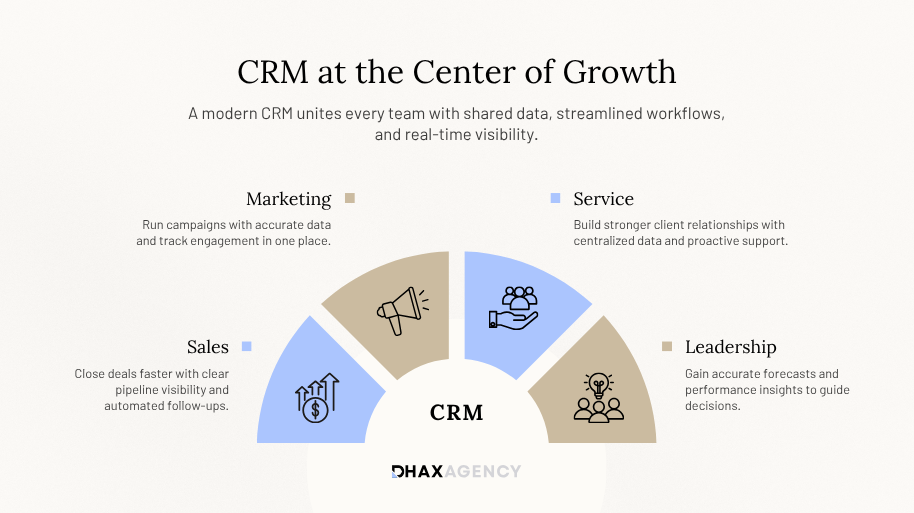
A CRM should be the central nervous system of your commercial operation. That means marketing, service, and even finance should feed into it.
- Marketing integration: Sync campaign data so sales can see which leads engaged with what content.
- Service integration: Track post-sale activity to support renewals and upsells.
- Automation: Trigger workflows, like sending a follow-up email or creating a task, directly from CRM activity.
Mini-case example: A manufacturing company aligned marketing and sales through a predictive pipeline built inside their CRM. By connecting campaign activity to sales dashboards, they could prioritize accounts showing the strongest buying signals. See the use case.
Step 3: Turn Data Into Proactive Insights
Recording deals isn’t enough. A CRM should help you see around corners:
- Pipeline health reports: Spot deals likely to stall based on gaps in activity.
- Lead scoring: Identify which accounts deserve priority outreach.
- Forecasting: Use historical patterns to build more accurate revenue projections.
When leaders and reps alike see the CRM as the single source of truth for predicting performance, adoption skyrockets.
Mini-case example: A SaaS company reactivated a stagnant lead database by using CRM insights to target dormant accounts with personalized campaigns. This turned dead records into live opportunities. Read the use case.
Common Pitfalls to Avoid
- Over-customization: A bloated CRM slows adoption. Start lean, then add fields or workflows as you prove value.
- Ignoring training: Teams won’t use what they don’t understand. Build onboarding and refresher sessions into your process.
- Measuring the wrong metrics: Track outcomes (conversion, cycle time, revenue influenced), not vanity stats like number of fields completed.
- “Set it and forget it” mentality: A CRM is never finished. Ongoing optimization is key.
Industry Mini-Use Cases
- Pharma & Life Sciences: A structured CRM ensures sponsor conversations stay focused on qualified opportunities. See how we helped an API Manufacturer personalize content at scale.
- Manufacturing: CRM alignment improves visibility into the pipeline and helps reps prioritize. Explore how we supported an Industrial Automation Sales Team with consultative selling.
- SaaS/Tech: CRM automation can prevent churn and accelerate onboarding. Read how we helped a Project Management SaaS reduce churn.
- Professional Services: Embedding CRM workflows builds consistency across the sales process. Learn how we streamlined sales for a Management Consulting Firm.
Key Takeaways
- A CRM is only as strong as the data and processes behind it.
- Integration across marketing, service, and sales is essential to unlock value.
- The goal isn’t a database, it’s a sales engine that predicts, prioritizes, and accelerates growth.
If your CRM feels like a cost center instead of a growth engine, you’re not alone. But the fix doesn’t require buying a new system. It requires using the one you have with more discipline, integration, and insight.
At DHAX, we help B2B companies transform underused CRMs into proactive sales engines that drive measurable outcomes. If you’re ready to get more from your CRM investment, let’s start the conversation.
Other Posts





© 2026 DHAX Agency. All Rights Reserved.